
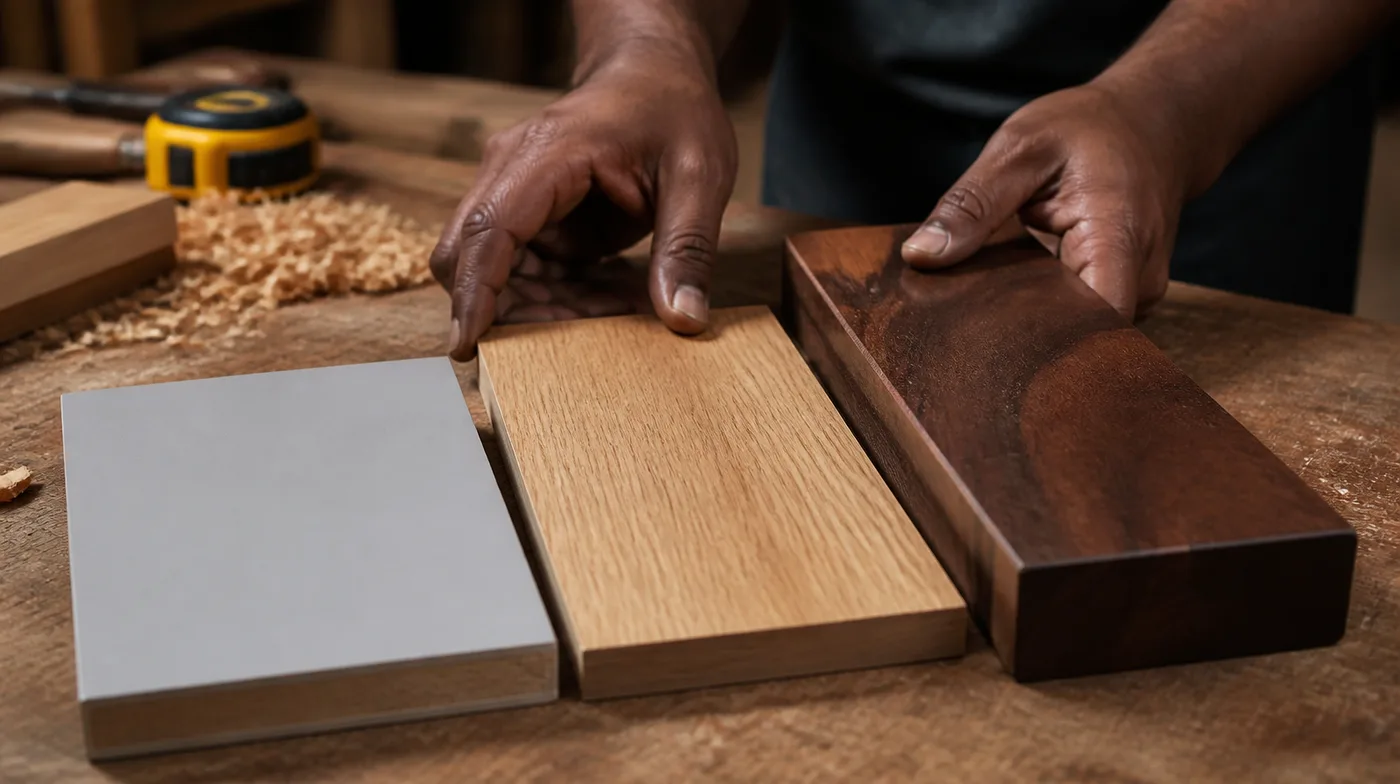
Three surfaces cover almost every office desk and table sold in Kenya: laminate, wood veneer and solid wood. They can look alike on day one. Ten years later they do not. Here is how to choose, based on what we see when furniture comes back to us for repair, and what we build in our own workshop.
What each one is
- Laminate is a hard plastic skin bonded to a board. The pattern can imitate wood, stone or a plain colour. Every piece is identical.
- Veneer is a thin layer of real wood, about half a millimetre thick, glued to a stable board. You get real grain, and no two pieces are quite the same.
- Solid wood is timber all the way through. Mvule, mahogany and cypress are the common choices here. It is the heaviest and the most expensive of the three.
How they wear
Laminate shrugs off pens, coffee, keys and cleaning sprays. It is the surface for desks that get used hard all day. Its weak point is the edge: if the edge strip is thin or badly fitted, it chips, and moisture gets into the board underneath. Ask for a thick edge strip, at least 2 mm.
Veneer scratches more easily than laminate and marks if a hot cup sits on it. It also fades in strong sun. A veneer desk by a west-facing window in Nairobi will be two shades lighter within a couple of years. Away from the window, with a coaster or two, it lasts for decades and looks better with age.
Solid wood moves. It swells a little in the wet season and shrinks in the dry one. Well-dried timber moves so little you will not notice; poorly dried timber cracks or warps within a year. This matters most at the coast, where the air is humid. Ask whether the timber was kiln dried.
Which ones can be repaired
This is the difference that matters over ten years.
- A damaged laminate top cannot be repaired. It is replaced. That is often cheaper than it sounds, since the top is the cheap part of a desk, but it is still a replacement.
- A veneer top can be lightly sanded and refinished once or twice, because the layer of wood is thin. Deep scratches go through it.
- A solid wood top can be sanded and refinished many times. A director’s desk in solid timber can be brought back to new every few years, for the rest of its life.
Where each one belongs
- Open-plan desks and workstations: laminate. Hard wear, easy cleaning, and every desk matches.
- Meeting tables: laminate for training rooms and rooms in constant use; veneer for the boardroom, where the table is on show and treated with more care.
- Executive offices: veneer for the desk and matching credenza. Solid wood where the budget and the room justify it.
- Reception counters: the front that visitors see can be veneer or solid wood; the working top behind it should be laminate or a hard solid surface, because that is where the bags, keys and coffee land.
- Schools and laboratories: laminate, with the thickest edge you can get. Nothing else survives a term.
Two things to check before you buy
- The edge. Run a fingernail along it. A good edge is smooth, tight to the top, and does not catch. Most desk damage starts at the edge.
- The board underneath. Both laminate and veneer sit on a board. Thicker, denser board takes screws better and sags less over a long span. Press down in the middle of a long top and see whether it gives.
Looking after any of them
Use coasters under hot cups. Keep bleach and abrasive cleaners off every surface; a damp cloth and mild soap is enough. Keep veneer and solid wood out of direct afternoon sun, or accept that it will fade. And if something does get damaged, ask about repair before you assume it needs replacing.
See and touch them side by side. Both our showrooms have laminate, veneer and solid wood on the floor. Samples of finishes can be taken away to match against your walls and floors. Just walk in.